

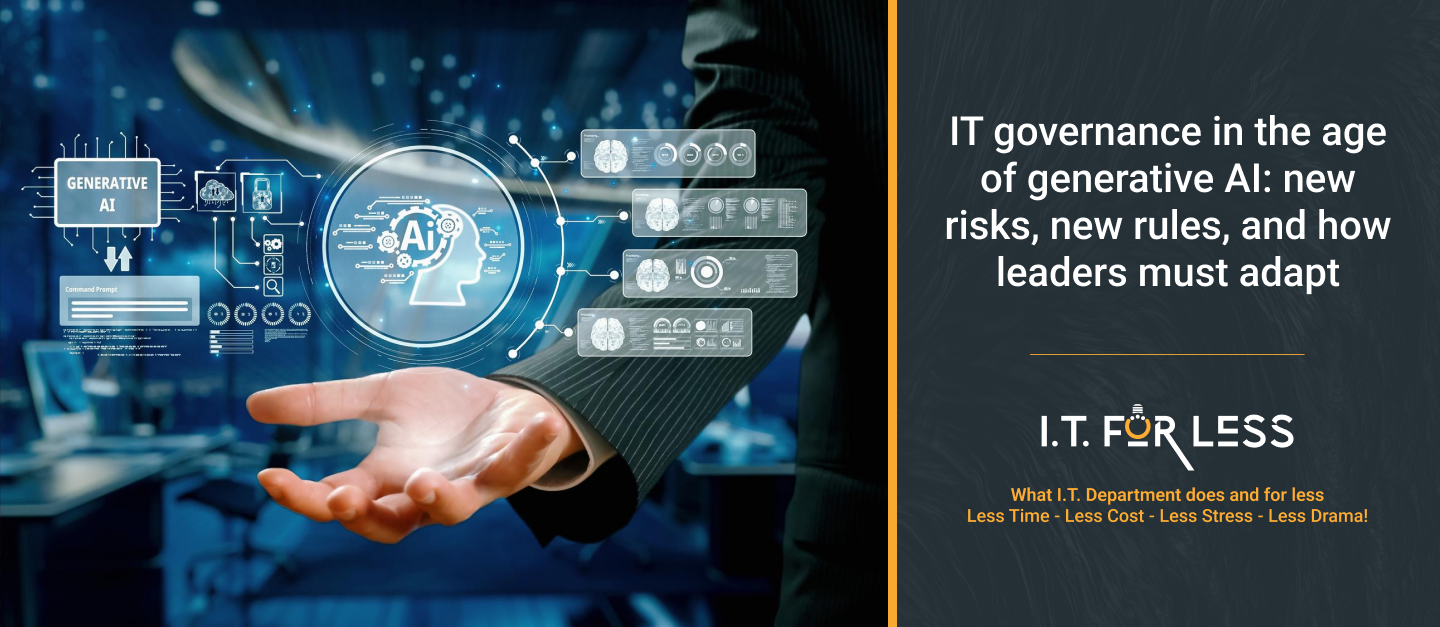
Generative AI is rapidly transforming the modern business landscape. From AI-powered chatbots and automation tools to intelligent reporting systems and content generation platforms, businesses are adopting Artificial Intelligence (AI) faster than ever before.
While generative AI creates major opportunities for innovation, productivity, and operational efficiency, it also introduces new challenges for IT governance, cybersecurity, compliance, and risk management.
Today’s technology leaders must rethink how they manage data, security, policies, and business operations in an AI-driven environment. Traditional IT governance models are no longer enough to address the speed and complexity of modern AI technologies.
In this guide, we’ll explore how generative AI is changing IT governance, the biggest risks organizations face, and how business leaders can adapt successfully.
What Is IT Governance?
IT governance refers to the policies, processes, and leadership structures businesses use to manage technology effectively and align IT operations with organizational goals.
Strong IT governance helps businesses:
- Manage technology risks
- Improve cybersecurity
- Ensure compliance
- Optimize IT investments
- Support business strategy
- Maintain operational control
As AI adoption accelerates, governance frameworks must evolve to manage new forms of digital risk.
What Is Generative AI?
Generative AI refers to AI systems capable of creating content, generating responses, analyzing data, and automating tasks based on user input.
Popular examples include:
- AI chatbots
- AI-powered writing tools
- Image and video generation tools
- Intelligent automation systems
- AI coding assistants
- AI business analytics platforms
Businesses are increasingly integrating generative AI into customer service, marketing, IT operations, and decision-making processes.
Why Generative AI Is Changing IT Governance
Traditional governance models were designed for predictable software systems and structured workflows. Generative AI introduces dynamic, self-learning systems that can create outputs autonomously.
This creates new governance challenges related to:
- Data privacy
- AI decision-making
- Compliance risks
- Intellectual property concerns
- Security vulnerabilities
- Ethical AI usage
Technology leaders must now govern not only systems and infrastructure but also AI behavior and automated decision-making.
Major Risks of Generative AI in Business
1. Data Security and Privacy Risks
Many AI platforms process large amounts of sensitive business data.
Potential risks include:
- Data leaks
- Unauthorized access
- Exposure of confidential information
- Third-party AI data storage concerns
Businesses must ensure AI tools comply with cybersecurity and data protection standards.
2. AI-Generated Misinformation
Generative AI systems can sometimes produce inaccurate or misleading information.
This creates risks such as:
- Incorrect reporting
- Faulty business insights
- Compliance errors
- Reputational damage
Human oversight remains critical in AI-driven workflows.
3. Compliance and Regulatory Challenges
Governments and regulatory agencies are rapidly developing AI-related compliance requirements.
Businesses must prepare for:
- AI governance regulations
- Data protection laws
- Industry-specific compliance standards
- Transparency requirements for AI-generated content
Organizations without proper governance frameworks may face legal and financial risks.
4. Shadow AI and Unauthorized Usage
Employees are increasingly using AI tools without IT department approval.
This “Shadow AI” trend creates major governance concerns, including:
- Uncontrolled data sharing
- Security vulnerabilities
- Lack of compliance oversight
- Operational inconsistencies
IT leaders must establish clear policies around approved AI usage.
How AI Is Reshaping IT Leadership
Modern IT leaders are no longer managing only infrastructure and operations—they are now responsible for AI strategy, governance, and risk management.
Technology leadership now includes:
- AI policy development
- Ethical AI oversight
- AI security planning
- Governance framework modernization
- AI vendor evaluation
- Employee AI training
This shift is redefining the role of CIOs, CTOs, and IT managers.
Key Areas of AI Governance Businesses Must Address
| Governance Area | Why It Matters |
| Data Privacy | Protects sensitive information |
| AI Security | Prevents vulnerabilities and misuse |
| Compliance Management | Meets legal and industry regulations |
| Ethical AI Usage | Reduces bias and reputational risks |
| AI Access Control | Limits unauthorized AI usage |
| Vendor Risk Management | Evaluates third-party AI providers |
Organizations that proactively manage these areas reduce long-term business risk.
Building an AI Governance Framework
Businesses adopting generative AI should establish a clear governance strategy.
Important Steps Include:
1. Define AI Usage Policies
Create clear rules for how employees can use AI tools within the organization.
2. Strengthen Cybersecurity Controls
Implement stronger monitoring, access controls, and data protection systems.
3. Monitor AI-Generated Outputs
AI-generated content and insights should be reviewed for accuracy and compliance.
4. Establish Ethical AI Guidelines
Organizations should define acceptable and responsible AI practices.
5. Train Employees on AI Risks
Employee awareness is critical for reducing misuse and security risks.
AI Governance vs Traditional IT Governance
| Traditional IT Governance | AI Governance |
| Focused on systems and infrastructure | Focused on AI behavior and automation |
| Predictable software workflows | Dynamic AI-generated outputs |
| Standard cybersecurity controls | AI-specific risk management |
| Limited automation oversight | Continuous AI monitoring required |
| Static compliance models | Rapidly evolving regulations |
AI governance requires more agility and continuous monitoring than traditional governance models.
The Role of Cybersecurity in AI Governance
Cybersecurity is becoming a core component of AI governance strategies.
Businesses must protect against:
- AI-powered cyberattacks
- Data manipulation
- Unauthorized AI access
- AI-generated phishing threats
- Model exploitation and vulnerabilities
AI-driven environments require proactive cybersecurity planning and advanced monitoring systems.
The Future of IT Governance in an AI-Driven World
As generative AI adoption continues growing, IT governance will become increasingly important for business stability and trust.
Future trends include:
- AI compliance regulations
- Automated governance systems
- AI risk scoring models
- AI-powered cybersecurity monitoring
- Stronger enterprise AI policies
Organizations that build governance frameworks early will gain a significant competitive advantage.
How I.T. For Less Helps Businesses Navigate AI Governance
At I.T. For Less, we help businesses strengthen IT governance through strategic IT consulting services, cybersecurity solutions, cloud management, and proactive technology planning. As organizations adopt AI-powered tools and automation, I.T. For Less helps ensure secure, compliant, and scalable IT environments that support innovation while reducing operational and security risks.
Final Thoughts
Generative AI is transforming how businesses operate, innovate, and make decisions. However, with these opportunities come new governance challenges that organizations cannot afford to ignore.
Modern technology leaders must adapt by implementing stronger IT governance frameworks, improving cybersecurity, managing AI risks, and developing clear policies for responsible AI usage.
In the age of generative AI, successful businesses will be the ones that balance innovation with governance, security, and strategic leadership.