

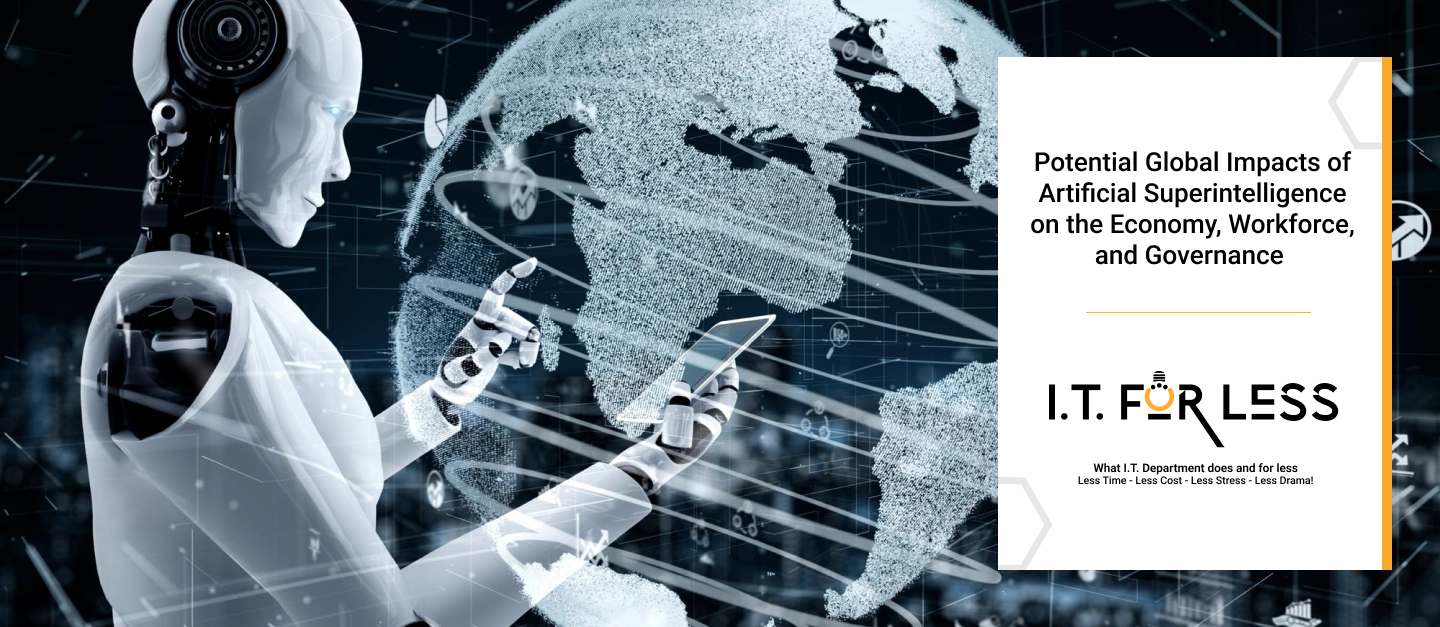
Artificial Superintelligence (ASI) — AI systems that surpass human intelligence across every domain — remains largely theoretical. However, its potential global impacts are profound enough that businesses, governments, and researchers must begin preparing now. ASI promises unprecedented efficiencies, innovation, and problem-solving capabilities. But it also raises significant economic, workforce, and governance challenges. Understanding these implications is critical for organizations aiming to navigate a future shaped by superintelligent systems. The economic and workforce effects of artificial superintelligence must be explored to grasp its full impact.
Economic Impacts
ASI could radically transform global economies by automating complex decision-making, optimizing supply chains, and accelerating research and development. Industries may experience dramatic productivity gains. However, these could be accompanied by market disruptions, wealth concentration, and shifts in competitive advantage. Early adoption, investment in AI infrastructure, and strategic governance will determine which organizations and nations benefit most from ASI-driven economic change. The effects of artificial superintelligence, economically and in the workforce, cannot be underestimated.
Workforce Transformation
The rise of ASI will redefine human labor. Routine, analytical, and even highly creative tasks could be automated. This will require a fundamental rethinking of workforce roles and skills. Reskilling, AI literacy, and human–AI collaboration will become critical, as employees shift toward oversight, ethical evaluation, and decision-making roles. Organizations that proactively prepare their teams will ensure smoother transitions and maintain productivity and innovation. Thus, the economic and workforce effects of such superintelligence demand urgent consideration.
Governance and Ethical Considerations
ASI introduces unprecedented governance challenges. Its autonomy and capability could outpace current regulatory frameworks. This makes oversight, accountability, and ethical alignment essential. Global coordination, clear compliance standards, and robust risk management strategies will be necessary to prevent misuse, bias, or unintended consequences. Establishing ethics committees and cross-functional AI governance structures today lays the groundwork for responsible ASI deployment tomorrow. To manage the economic and workforce effects of artificial superintelligence, ethical standards must evolve in tandem.
Navigating the ASI Future
While ASI is still on the horizon, understanding its potential impacts enables organizations to plan strategically. Early preparation in governance, workforce development, and ethical oversight transforms uncertainty into opportunity. This ensures that superintelligent systems augment human potential rather than disrupt it. Ignoring the workforce and economic effects of artificial superintelligence could lead to unforeseen challenges.
Partner for Future-Ready AI Strategy
Partner with I.T. For Less today and take the first step toward building a secure, ethical, and adaptable AI foundation—keeping your IT flowing as effortlessly as your ambition while preparing for the next era of intelligent systems.